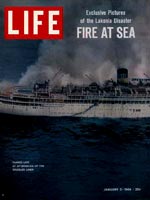
 Forty seven years ago, passengers on the cruise ship Lakonia were promised “a marvelous Christmas cruise to sunny Madeira and the Canary Islands.” The brochure read – “Have your holiday with all risk eliminated. Enjoy a holiday you will remember for the rest of your life.” When the fire broke out on December 22, 1963, the promise of a risk-free holiday proved tragically ironic, though the promise of a unforgettable holiday, no doubt, became regrettably too true. One hundred twenty eight 128 people died in the Lakonia fire and its aftermath, of which 95 were passengers and 33 were crew members. Given the recent news that the CO2 firefighting system on the Carnival Splendor failed during the fire aboard the ship in November, the story of the Lakonia remains timely. Notably, AMVER, which we posted about recently, coordinated the rescue by directing five merchant ships to the burning ship. The first ship arrived within four hours of the first distress call. As reported by Time magazine on January 3, 1963:
High Seas: The Last Voyage of the Lakonia
Two nights before Christmas, the ship was in a festive mood. In the main lounge, Captain Zarbis was judging costumed contestants at a Tramps’ Ball; first prize—a bottle of white wine—had just been awarded to a 13-year-old girl in beatnik tights when alarm bells started to ring. In the ship’s cinema, where Bob Hope was cavorting on the screen with Anita Ekberg in Call Me Bwana, the audience at first thought that the ringing bells were part of the film’s plot. But the smell of smoke soon convinced them that something was amiss. Other passengers who had gone to bed early were not yet fully aware of the danger. No fire instructions were issued over the loudspeaker, and the alarm bells stopped ringing so quickly that many people thought it was only a drill.
At 12:22, shortly after Captain Zarbis gave the order to abandon ship, the last mayday message was flashed: “S O S from Lakonia. Last time. I cannot stay any more in the wireless cabin. We are leaving the ship. Please help immediately.”
More than 3,000 miles away, the distress signals were picked up by a U.S. Coast Guard station. The Lakonia’s position was immediately fed into an AMVER (Atlantic Merchant Vessel Report) computer, which plots the location, course and speed—and records such information as whether a doctor is on board—of some 850 merchant ships in the North Atlantic. Within moments, the computer’s memory drums typed out the names of five vessels within 100 miles of the Lakonia, and urgent messages were flashed to them to proceed to the stricken liner. The five were the Argentine passenger liner Salfa, the Belgian merchant ship Charlesville, the British freighters Montcalm and Stratheden, and the Brazilian freighter Rio Grande. Some were already on the way, having picked up the S O S on their own radios. The R.A.F. at Gibraltar hurriedly organized a flight of rescue planes.
Screams in the Air. At Lajes Air Force Base in the Azores, the U.S.’s 57th Air Rescue Squadron also swung into action. Shortly after the Lakonia’s last message was received, four C-54 rescue planes swung out over the Atlantic toward the flaming vessel, 3 hr. 30 min. flying time away. The planes were loaded with 42 life rafts that could carry 600 persons, 400 blankets, food and survival packages, flares of 300,000 candlepower, and six paramedics who could jump into the ocean to help passengers, if necessary.
On board the Lakonia, the nightmare was all too real. With the loudspeaker system not operating, there was near-anarchy on deck. Officers issued contradictory instructions, and crewmen milled around unsure of what to do. Screams filled the air in half a dozen different languages. Unable to comprehend the crew’s cries, passengers took charge of small groups and tried to lead them through the thick smoke to their boat stations. Pressed against the rail were scores of passengers in every variety of dress—nightgowns, pajamas, tramp costumes and evening clothes.
The water was 64°, but many of the children and the elderly passengers were soon dead nevertheless. As dawn broke, the rescue fleet, now swollen to some 20 vessels, looked out on a vast scene of lifeboat debris and bobbing bodies. Despite the calm seas, it was not easy to pick them up. The rafts and lifeboats kept banging into the windward side of the waiting merchantmen; hour after hour the arduous task continued, until at last all the living and dead were hauled aboard. On the Salta, which picked up 478 people from the sea, cognac and blankets were passed out to the shivering survivors, but the crush was so great that soon there was not enough of either to go around. The British aircraft carrier Centaur picked up 55 bodies, then dispatched a helicopter to the Lakonia to see if anyone was still on board; from the vessel, a British officer reported that the liner was a burnt-out hulk. As the rescue ships sped from the scene toward the port of Funchal in Madeira, the ruined liner was taken into tow by the Norwegian salvage tug Herkules.
Thanks to James Walker at CruiseLaw for tweeting about the Lakonia tragedy.
This is an excellent reminder of the risks of seagoing. It should be sent to the propaganda – oh Marketing – Departments of ALL Cruise Lines, the CLIA, USCG Marine Safety Offices and NTSB. It is beyond time to a standard for correct and truthful advertising in the cruise industry. Disasters are a series of small incidents which combine and grow to the major event. We are seeing a very troublesome series of incidents in vessels increasing in size, complexity and the number of persons on board, now nearing 5000. Crew standards are NOT improving at the same rate according. Presently serving Officers who are greatly concerned and are contacting me more and more. NAUTICAL LOG is going to take a highly active role and will be posting on this subject during the coming year of 2011. Speculation is not a bad thing when applied logically and aimed at preventing these incidents. Sadly one fears that the major incident is about to happen most likely on one of these floating resorts with 4000-5000 persons aboard.
Good Watch.
My grandparents survived this tragedy despite the fact that they floated around in life jackets for hours before they were rescued. The few lifeboats available were immediately picked up by the Greek crew who deserted the scene immediately. The fire started in the kitchen,and passengers were informed quite a long time after the fire began. There were many elderly people on board since it was a winter cruise, and many children since it was the Christmas holidays. Many people were rescued too late and died in the freezing water. My father flew out from London to Madeira, thankful that his parents had survived although they were very ill and in a hospital in Funchal. A lawsuit ensued for many years afterwards as surviving passengers and relatives of those who died fought for compensation. Most of the elderly passengers who survived, including my grandparents, continued to have health problems til the end of their lives.
Sometime about 1967 – 68 I met a man and his wife who were aboard the Lakonia on that fateful cruise.
They recounted that they met a survivor of the Titanic sinking who was also
on the Lakonia and who ended up in the same Lakonia lifeboat as they.
This gentleman was a child in 1912 and is understood to have participated in the BBC 1962 commemorative programme featuring Titanic survivors.
I have endevoured to find some record of a Titanic survivor being on the Lakonia but without success and I wonder whether anyone else has heard anything of this incredible coincidence.
I started working in Thos Cook in Berkeley Street in 1964 as a junior shorthand-typist. At that time travellers cheques were very popular as credit/debit cards were non-existent. My office dealt with those cheques belonging to both the survivors and deceased of this tragedy. I can remember each cheque being cellophaned for handling. The serial numbers were checked for ownership and then I helped prepare correspondence to customers and solicitors. Reading this article brought back many memories.
there were quite a few of my family on the Lakonia that day my auntie was never found. I have been searching for a passenger list but upto now have never found one. thanks for information. JAN
My Uncle was on the Lakonia. He was born in the North East of England. He met and married a Guernsey girl and they ran a smalll hotel in Guernsey established by her father. As they were in the hotel nudiness holidays were taken off season, he was travelling alone his body was washed ashore, I cannot remember where.
Fascinating to still read comments about this disaster as recently as just a few weeks ago.
My grandparents were aboard and survived and my only recollections as a seven year old were of a photographer and journalist arriving at my parents house in Glasgow to do an article with my father about his parents being found safe and well and taken to Madeira to recuperate.
Some years later we found a diary my grandfather had kept of the cruise where he alleged that many of the crew fended for themselves and had no thought at all for the passengers.
I remember that night very clearly, I was sitting at the captains table at the tramps ball with my family when an officer came to the table to report the problem, we knew there was a problem as smoke was drifting in as he came through the door.
I was then 21 years old and on holiday with my parents ,sister & aunt. We were the only large party to survive intact!
My father ( ex regimental sgt major& Dunkirk surviver) said ” give me a hand and we will be fine – this lot haven’t a clue” He insisted on making sure that all the woman were on the lifeboats first.
He and I left the ship on the last lifeboat when the flames were leaping 50 feet or more into the sky. He gave away our life jackets as we could swim , my mother gave him a hard time about this for years.
The life boat my mother sister, & aunt was on drifted under the bilge pumps and filled with water,my sister was hit with an oar in the confusion and was knocked out. There is no doubt that she would have drowned if my mother & aunt hadn’t held her head out of the water until she recovered her senses.
Our boat had the wireless, however the W /O forgot to bring the morse key! We also had an engine, however the officer in charge was useless , he did not stop crying. My father threatened to kick him in the nuts at one stage as he kept holding on to him and sobbing.
The 3-4 crew members did nothing to assist, the german stewards and the passengers on the other hand were great. I rowed most of the night with one of the stewards sharing an oar , my father was also rowing with another steward, some of the row locks were missing so we could not use all the oars. If you we’re there that night you may remember the parachute flares that were sent up ( that was me) I broke open the flair locker and thankfully the instructions were in English. I do believe that there were no other flares sent up that night.
We were amazed when we could suddenly see in the light of the flares dozens of people in the water, however we could not get to them – I think about that to this day – most of those people must have died that night!
At daylight we were picked up by the Salta, suddenly the crew came to life and scrambled up the ladders ahead of the passengers pThe officers of the Salta had to restrain their crew who wanted to throw them off the ship. I heard one shouting ” real sailors don’t behave like that.
I remember being given cognac and a blanket by a nun who also stuck a lighted cigarette in my mouth! ( I was no t a smoker – but it seemed impolite not to accept it).
The Salta was taking immigrants to South America, the passengers were not wealthy People ,but they and the crew .were so generous we had the best possible treatment they could under the circumstances.
My mother’s boat was picked up several hours later, she. Yelled out “get the kettle on” as she was being pulled up – as tough as nails , her sense of humour still intact.
We circled the area for a two days,picking up survivors and bodies, we ended up in Madeira. We were taken to Reid’s Hotel and stayed there for a few days including New Years Eve, t he party at Reid’s was bizarre – we were excused evening dress – Sandy Gaul the ITN reporter who was there was three sheets to the wind and kept us amused by using the rolls of film as party streamers!
Almost 50 years have passed since the incident now and this is the 1st time I have written about it, I have all the. Press cuttings and around Christmas time each year I look a t them and count our blessings.
Norman Geller
I was crew member of SS Stratheden which steamed to help the rescue of
passengers but we understood that wrong ships position was provided, hence we arrived after all other vessels. The public room I worked in was stripped of all furniture and replaced with camp-beds. Our grand piano we were given to believe would be used as operating table (we had a surgeon on-board), but non of this was used due to the late arrival. Just a few seriously injured were
taken aboard.
My Grandad was on the Lakonia. He was picked up from the water. He was 75 years old. He had a knee injury and always walked with a limp after that. I was 9 years old at the time and i always remember my father saying they found out he was still alive on Christmas Day.
I was on board HMS Centaur. We had just left Portsmouth for our deployment to the Far East when the engine speed picked up and we went to join the rescue. When we arrived at the scene the Laconia was still on fire and sadly we were tasked with collecting and preparing the bodies recovered for delivery to Gibraltar on Christmas Day. Our crew responsible for preparing the bodies were issued with an extra rum ration to help them in the task.
For our humanitarian assistance, the Centaur, having missed the transit convoy through the Suez was allowed to transit on her own
My father ,step mother ,uncle and aunt were passengers on the Lakonia and were rescued by the Montcalm,except my uncle who drowned and I believe is buried in Gibraltar,but this has never been confirmed. Can anyone confirm this?
I was on the Lakonia aged 6 with my older brother Stuart and my parents Valerie and Alan. Thank god we all survived due to the ability of my father to find his way from our cabin to the top deck in total darkness due to the acrid thick smoke. He says that he had some sort of premonition and had memorised the route. We all held hands and felt our way. My father always maintained that it was he who raised the alarm as he was playing bridge late into the night and smelled the smoke. After reaching the top deck, I have memories of the lifeboat lowering mechanisms being seized, rusty and non-functioning. We had to cut the supporting chains at both ends of the lifeboat with axes, hoping that they would snap at the same time. I understand that some did not, and the lifeboat occupants were tipped into the sea. We spent many hours in the lifeboat. I was constantly seasick over my father before we were eventually picked up by the Montcalm. I remember holding onto the shoulders of a sailor who climbed up the net onto the rescue boat. We were taken to Casablanca from where we flew home the following day after spending the night in a local hotel. I will never forget that particular christmas and I have never been on a boat cruise since.
I was the Chief Engine Room Artificer of the arresting gear crew on board HMS Centaur and was working on the flight deck as the dead were collected by our helicopters and sea boats. I can assuire relatives and survivors that every care was taken, as far as the circumstances allowed and the dead were treated with respect. All were medically examined, photographed and dental notes were made to assist later identification. We had no body bags: all were sewn in blankets and stored in a cooled aviation weapons magazine. They were landed in Gibraltar on Christmas Day and I believe most were buried there. The effect on Centaur’s ships company seeing the dead men, women and children, was quite devastating. We had left our own wives and children a week before Christmas to get to our duty station, East of Suez, to allow HMS Ark Royal (I think) to get home for their families. Although I left the Royal Navy in 1972 and have lived 41 years in New Zealand that episode left me with lasting, not very pleasant memories. My best wishes to those attending the 50th anniversary memorial ceremonies in Gibraltar later in December.
I was also on board H.M.S.Centaur, I was 17 years of age and nearly 50 years on the events are still very much in my mind.
About 6 years ago I started searching for information relating to where the victims where actually buried, and at that time there was very little information available on the internet.
I eventually started to get help from Andalucia.com, I am a member of the forum and some of the members actually worked in Gibraltar so they where able to assist me.
So several years have now passed since I started my quest, and I will be attending the ceremony in Gibraltar on Friday 6th December, 2013, almost 50 years after the tragedy, where a plaque will be unveiled on that day to remember that tragic time.
There is much information available about the T.S.M.S Lakonia tragedy at Andalucia.com, and I can be also contacted there, if anyone requires further information.
Gordon Holme
Yesterday 25th. November 2013, I spoke with Patrick Gleeson of Limerick, Ireland. Pat was the Radio Officer of the m/t. “Montcalm” and his story was published in ” The Radio Officer Story 1900-2000 – The Long Silence falls………………. Pat is a true gentleman and now in retirement lives with his wife and family in Limerick. Pat done an excellent job as a Marconiman — Christmas 1963. All Remembered 50 years on. Colman
The evening before the 50th anniversary of this disaster I’m feeling quite emotional but incredibly lucky that my family of six all survived. My mother, grandmother, sister, brother and I were in one of the fortunate lifeboats (that stayed upright) for 8 and a half hours and were picked up by the Salta. I was 13 at the time. We were taken to Madeira and stayed at Reid’s Hotel. My father swam for over 4 hours. We had the most wonderful present on Christmas Day when we discovered he was still alive.
My mother wrote an interesting 8 page account of the disaster and she would be happy to share it with anyone who would like to read it. I can be contacted at jillt2424@mail.com .
Jill Tovey
Somerset
I too had relatives aboard but this disaster happened seven years before I was born. My great uncle Roy Wilkinson and his wife, Elizabeth (known as Bish) were survivors but their two young boys, aged around six and eight sadly were not. They were asleep in their cabin whilst their parents dined. Nobody could get to them. It’s heartbreaking and I only found out as my son came home having been taught about this Christmas Cruise, with this year, 2013 being the fiftieth commemorative anniversary of the disaster. I knew an incident at sea had involved my family but assumed it was much longer ago than 1963 and the family had never mentioned christmastime. So devastating to find out. Earlier this month, a group of people related to the disaster met up in Gibraltar and ensured a plaque was placed to commemorate those list and celebrate those who survived.
Sadly I feel now that I will feel affected every 22nd December. It’s something I wish I had known earlier in my life when I could maybe have spoken to my great uncle Roy if he felt able to discuss it.
I has two others was serving on hms centaur at the time of the disaster, they say it was traumatic for our ships company,but to hear the stories confirmed about the greek crew who left a lot to be desired in the safety of the passengers,was more traumatic for the passengers that these so called seamen didn’t have a clue, which led to this tradergy I personally have never forgot this xmas cruise my heart goes out to all the families that lost loved ones on that fateful cruise at the time I was just 19 to see all that at an early age leaves a great sadness
just brought back a very sad memory of that terrible time xmas 1963 aboard hms centaur who had the unenviable task of recovering the lost souls that perished they were treated with the upmost respect as befitting the men who servedand had the task to recover the bodies my heart goes out to those who suffered such a great loss I will never forget those lost souls who I never knew god bless to all familys
My grandmother was 65 and was a survivor of the Lakonia tragedy. All the lifeboats had gone and she resigned herself to going down with the ship. An older man convinced her to jump which she did, injuring herself terribly on the furniture in the water. But she was a very strong swimmer and swam away from the ship alone into the night. She was picked up 7 hours later by a light shining on her saying we have got you. A well as terrible facial injuries she had broken almost all the bones down one side.
My grandmother was 65 and was a survivor of the Lakonia tragedy. All the lifeboats had gone and she resigned herself to going down with the ship. An older man convinced her to jump which she did, injuring herself terribly on the furniture in the water. But she was a very strong swimmer and swam away from the ship alone into the night. She was picked up 7 hours later by a light shining on her saying we have got you. A well as terrible facial injuries she had broken almost all the bones down one side. She was called to give evidence against the captain. She was left with one shorter leg and had several plastic surgeries but happily lived on till 93.
Today I took a walk round our local cemetery once again reading some of the very interesting names and facts of people long gone including some relatives and a number of old friends.
One grave I always visit is right at the bottom of the cemetery facing Horselunges Manor in Hellingly, East Sussex. There is a large family grave and a photograh of a woman and a small boy.
The writing has faded terribly over the years, but they lived at the manor and it says they were drowned on the Liner Lakonia in 1963.
I have always been intrigued and now I know their story.
I can only assume their bodies were brought home.
Years later it says her husband was buried there too, Major Fishenden.
They face their beautiful home which is I think rather nice.
In reply to David Hollman’s post ex C.E.R.A H.M.S. Centaur.
At the time of this tragedy I was serving on H.M.S. Ark Royal, and indeed it was the Ark that was at anchor in the Suez Bitter Lakes, our homeward passage delayed whilst Centaur responded to the tragedy unfolding with the Lakonia. We had sailed from Aden and whilst in Aden at anchor we had a fleet smoker ( concert put on by the ships company) with American guests onboard. The news filtered through that JFK had been shot. a helicopter arrived to take off 3 U.S. Officers back to their ship, the helicopter ditched and all five onboard were killed. So this period was uncertain and gloomy with the Lakonia sinking too. Back home on leave in the Midlands I sort to buy my first car, next to the car I eventually bought was a beautiful Armstrong Siddeley with the perforated door panels. I was told that the previous owner had perished when the Lakonia sank. Quite a coincidence and a sad reflection for me. Respects to all who lost loved ones on the Lakonia and other maritime disasters. M.G. Ex R.N.
I’d be interested if anyone connected with the Lakonia tragedy knows about one victim, Dennis Vernon, who was a US government employee.
Both my parents were aboard the Laconia and happily both survived. Neither of them ever spoke much about that time and I would really like to get a better understanding of what actually happened to them. I know they were both in the same lifeboat and the only vague story that I remember is my father saying that their boat had taken on water from bilge pumps. I think therefore it may be connected with the story from Norman Geller above and I would love to hear from him or anyone else who can fill in any gaps for me. contact:- andygriggs42@gmail.com
I am the sister of Andy Griggs (above). After the Lakonia disaster in which both our parents survived, our father Percy Griggs organised the presentation of a plaque giving thanks to the crew of the s.s Salta in which he and our mother were rescued. The plaque was presented to the captain of the Salta at the Argentine Embassy in London and from then on was attached inside the rescue ship as a mark of respect and thanks to the crew. Many of the survivors contributed to the cost of the memorial.
I was just 10 years old when I went with my parents on the Lakonia for the Christmas holidays. My father became ill soon after we left Southampton and was in fact in the ship’s hospital at the time that the fire broke out. Because of this he was able to come on the lifeboat with my mother and I. I remember being terribly sick all over a lady’s mink coat – she was sitting opposite me in the lifeboat! We were rescued by the Salta and as my father was being pulled up the side of the Salta from the lifeboat he seemed to lose his hold and fell between both the boats. Fortunately they managed to pull him up to safety. However, once we arrived on Madeira he was taken to the English Hospital in Lisbon where he remained for 2 months. My mother and I stayed in a hotel in Lisbon – I’ve completely forgotten the name of the hotel now. When we finally returned to the UK we arrived back to our house only to find that word had got out that a ‘local estate agent was on the ship that went down in the Bay of Biscay and had been badly hurt’ and burglars had been into our house and completely cleared out anything of any value – not the best homecoming!
I wish I had known about the 50th Anniversary Service I would love to have gone. Both my parents have now passed away but I still recall the events of that night. I know that I would never ever go on another cruise!
I am from Argentina. My Father Ramón was one of the Salta´s sailors . He participated in the rescue. I was 2 years old at the time. My father always told me about that moment. He received one medal for his heroism … All the rescued people joined money to give them to the rescuers..but that money was donated to an institution for help against Poliomyelitis . The rescuers did not care about medals or money … They was happy for helping … a human being helping another human being regardless of language or religion or flag.☺ ♥♥♥
Jill, I will send you an e-mail…i am intetested in your mother report
Now I am supporting a facebook group to keep searching an argentine sailbout lost in the Atlantic. Here to help http://en.buscandoaltunante.com.ar/
I’ve just been reading my Grandmother’s letter to my parents on Christmas Day 1963 recounting her dramatic rescue from the Lakonia, just a few months after I was born. My grandfather was in the engine room of the ship as the test engineer for the company that made the engines. My grandmother had gone with him for the trip. She refused to leave with the other passengers as she wanted to leave with my grandfather. In the end, she was one of the last to leave, lowered down dangling on the end of a rope to a life raft dropped by one of the American planes. My grandfather fell in but was hauled aboard another raft, so they were both safe. Each raft was picked up by a different ship. My grandmother who wasn’t very tall said she had to climb netting and ropes to get aboard her rescue ship. She was taken to Madeira but then had an anxious wait to find out where my grandfather was. They were reunited in Casablanca 10 days later. They didn’t talk much about it in later years other than about the chaotic instructions that made some people think that they had time to pack their cases. In the end they lost everything they had taken and only had the clothes they stood in. My grandmother was upset at losing all her jewellery. They both lived into their 80’s.
Hi , my grandfather was on board this ship when she caught fire , he was an X SAS officer in WW2 so a pretty good swimmer , he managed to pull a large lady and a child miles in the dark to a beach , the lady died just as they reached the shore , the child survived and i always wanted to find that little boy , he never felt right after that and a year later died from a heart attack , doctor said the strain from the swim had killed him , his name was alf hebert wagstaff …from leicester…
Refernce to comments by S Gothard re Lakonia.
My parents were married in 1937 and went to Guernsey for their honeymoon. Also in 1938 and stayed at the Petite Bot hotel owned by Mr & Mrs Noble. When war came they evacuated and came to stay with us in Romford, Essex I was born March 1940 and I remember the five of us sleeping in an air raid shelter at the bottom of the garden. We had holidays there in 1947 & 1948. I thought it great playing on the German guns. My mother read in the Daily Telegraph the casualty list and Mrs Noble of Petit Bo was listed as one of them.
To S Gothard. Please contact me. on “abrsar@talktalk.net”
My Patents married in 1937 and went to Guernsey for their honeymoon and stayed at the Hotel Run by Mr & Mrs Nobel and again in 1938. When they evacuated the Island in 1940 they wrote to my parents and asked them if they could find them accommodation. My parents replied come and stay with us then you can find your own accommodation. I was born in March 1940 and my first recoclections of life was of 5 of us sleep every night in an air raid shelter at the bottom of the garden. They went up to Newcastle to work in a munitions factory. The reason they got on so well was because my mother came from Newcastle. We h holidayed there again in 1946 & 47. My mother later read in the Dailky Telegraph about the disaster and Mr Nobel was one of the casualties,.
Bernard Reynolds, Kings Lynn, Norfolk.
to all concerned
i was a seamen on cargo boat MONTCALM the first mate ,my mate alf and
myself spent from seven in the morning till four in the afternoon in our
liveboat picking up people from the sea taking them back to the montcalm
hoisting them up to the deck JUST DOING THAT WAS DANGERS then back
to looking for more survivers till four in the afternoon.
By the way the doctor that done the surgery on the person that had there
throat cut , came from the RIO GRANDE with his wife she was a doctor to
My grandfather, Theodore Kopff, (Bremerhaven, West Germany) was a musician on board this cruise liner. Some how, someone took a picture of what was happening during those terrifiying moment at sea. He and other crew members were handling a firehose. He perished on board that ship. His final resting place is known to my mom and grand mother, who are now deceased as well. Does any one know where some of the crew final resting place are? Mel
In the January of 1964 l and number of others were in the school cloak room at Windermere Grammar School and a younger pupil “Scottie” was telling us about his experience he had lived through the Christmas of 1963 & of the disaster of the Lakonia. I can not recall his Christian name, but his parents owned a hotel in Ambleside. One thing l always have remembered was he said the crew were abandoning ship before the passengers.
Good morning. I hope you can help me. For years i have been reuniting WW2 evacuees with wartime friends. I have been contacted today by Bernard Reynolds whose family took in Mr and Mrs Noble, two adult evacuees from Guernsey, during the war. Mr Reynolds read your website about the Lakonia and saw the following comment “S gothard says: November 30, 2012 at 5:50 pm My Uncle was on the Lakonia. He was born in the North East of England. He met and married a Guernsey girl and they ran a smalll hotel in Guernsey established by her father.” Bernard is sure that S Gothart’s Uncle is Mr Noble, the Guernsey evacuee that his family took in. Would it be possible for you to pass my email address on to S Gothard, with this message, if your have his email address logged in your website somewhere? Thank you for your time in reading this email. Kind regards, Gillian Mawson, Derbyshirfe, UK
I to was on the centaur on that horrible day. I was attached to the flight deck. as LME. incharge of fuelling Acraft. hellecoptors. Etc.
I do think of that day. from time to time. rest in peace.
I was 10 years old and went on a cruise with my parents and brother on the Lakonia. This was the trip previous to the tragic events of December. My brother was studying at London Nautical School and pointed out that fire drill was always carried out with the same lifeboat. All the others were painted over time and again, making them virtually impossible to lower. If a 14 year old can spot this problem, why could nobody else? Does anybody know what happened to Fritz the barman?
My grandad was on board the Lakonia. He was rescued by the Greek ship. He had damaged his knee and always walked with a limp after that. I was 9 years old at the time and I remember it was Christmas Day when we found out he was safe. He must have been in his 70s at the time because he died in 1972 aged 84.
Every Christmas from born we all cry in our house. i was not born then, however my Father was the head waiter on the Ship, he has sat us down every Christmas and has explained the whole story on how the ship went down and how the ship caught fire. during them years the true story did not come out people were to scared to talk, even until now know one really understands the truth. he saved many people as he was one of the last to get off. he even punched a fellow worker across the face as he was crying and screaming whilst helping passengers to get off. his life boat was full but he gave his place to other passengers to get on. lucky for him but not for others that boat turned over and everyone on board capsized in to the sea. safety errors from the crew. he is 78 now and still not a day goes by without him thinking of the ship. he saw friends and passengers die he gave one guy the kiss of life and kept him alive. Iv told him to write a book from his side on what he saw, he told me No because in his words YES many were saved but so many did not make it. as a mark of respect No book.
He sleeps with a photo of his best friend from a previous ship both of them smiling with the ship and sea in the background. His best friend died that night.
My parents were on the Lakonia cruise previous to the tragedy and were horrified to see the news that Christmas. Would I be right in thinking they left from Southampton ? I have a recollection ( as a small child) of going on board before the ship left port . They had absolutely loved their cruise and my mum kept copies of all the beautiful dinner menus and many other artefacts and souvenir photos until her death. Just behind me ,on the sideboard, I have a photo of my 6 foot 3 inches slim father with the diminuitive Captain Zarbis. My mother always insisted he was an absolutely charming man and felt sorry for him when he was court martialled. I was given to believe all those years ago ( and I don’t know if it is true) that the Captain was the last (or one of the last) to leave the ship.
Sincere condolences to all those touched by this appalling tragedy. I am struck and deeply touched by how vividly and eloquently everything is recalled by the passengers and rescuers and by their brave stories.
I just read Frances Lulham’s post (May 15 2014)and was very moved as I had been looking on the internet for any mention of a little boy I used to play with who was drowned with his mother on the Lakonia and there was Frances’s description of the family grave that she had just visited. The little boy was Nicholas, the same age as myself, and we used to play together in the playground of a club in London our families belonged to. I think his mother’s name was Heather. She was much younger than Nicholas’s father (2nd marriage, I think) and very pretty. It IS nice to think they are all there together by their home. I have never forgotten Nicholas and what happened to him and his mother.
Does anybody recognise the name Merton J Mason, who was on the Lakonia and the list states that he died onboard the ship. I don’t know if he was a passenger or a crew member, he was aged approx 35 years old.
I was a lucky survivor with my Mum. I have loads of paper cuttings and some telexes which are amazing from the Salta to UK. Also from the Arcadia to my Father in the UK. I even have the tag with my cabin number on it, but the actual key has been wrenched off. What do I do with all this? Any suggestions welcome. Julia (Nee Morgan)
Death of Richard Burca, survivor of the Lakonia disaster. Richard, 15 at the time, was one of the sons of the manager of Reids Hotel on Madeira.
He was returning home to Madeira, from school in England with his brother.
He had been ill for some time and died early in August 2015.
http://www.madeiraislandnews.com/2015/08/richard-burca.html
I hope this information is of interest to this blog.
Richard Turner
i am setting here with TERRY MOORE he was one of the crew ofthe ship and helped save ppl rescue in 1963 he now lives it altoona. p.a.- u.s.a as his friend i say GODBLESS you as a good friend he is…
My grandfather was Theodore Kopff (65) from Bremerhaven, West Germany. He was a musician on board this cruise liner. Mel, Omi would talk about this tragic day and mentioned that Opa was taken to Morocco where he was laid to rest. If anyone has any information on this, please let us know. Thank you Rob
To Cynthia Nicholas (née Neary) – posted September 2013: Was your uncle Fredric Neary? Did anyone respond to your question?
I sit here reading all these stories and it simply gives me goosebumps, my father was a crewman the night of the fire. I only today started researching more about the tragic accident and it is exactly how my father explained to us many many years ago. My father is 80 on the 27th of December he was born in Chios Greece he was 5 days away from 28. I sat next to him tonight as he was re-living the past with his sister. I would love to hear from anyone who was there or has a story, I would love to locate I think it could be the navigators son who my father saved from drowning, he handed him over in Casablanca the baby was 2-3 years old. My father also saved a lady from England he was treading water for a few hours before he was rescued. My father constantly reminds us how the lady he rescued issued an official complaint as he accidently touched her breast at the time he was trying to save her. As we all know the ship started to burn at approx 11pm it was dark he couldnt see a thing. Nearly all the survivors were placed in quarantine for about 7 days my father was made to defend himself regarding the allegation. I would love to hear from anyone. thank you
I would love if Adeline Julia Ives would contact me as my father was on the Arcadia prior to Lokonia. We live in Australia. andrew-001@live.com or +61447219113. Please wouldnt it be amazing if we could arrange a reunion.
I was on the Stratheden with my parents and brother and remember the engines going full blast during the night to reach the Lakonia (normally they were much quieter at night). We passengers were all asked to donate an item of clothing to the survivors as we were the only passenger ship in attendance. We were told that back of the ship was made into a morgue but there were no bodies taken on board.
I now know That Merton Jack Mason was a Cruise Director on the
Lakonia, he was aged 41…he was, according to his death certificate, drowned. I am trying to find any survivor who remembers him, plus the place where he is buried. Anybody know ??
Jff
Having just turned 21 three days before the Lakonias distress call I was the youngest officer on the MV Montcalm. Our own voyage had not been without incident as we were caught up in Chicago in late November due to the JFK assassination. This delay combined with early winter ice setting in meant we had to miss ports in order to clear the Great Lakes before being stranded until the Spring. When we left the St. Lawrence Seaway we were unable to get alongside in Montreal due to ice and with the help of icebreaking tugs berthed in Quebec taking essential cargo we needed for stability to cross the Atlantic.
Our first port was to be Casablanca and on the early morning of December 22nd we received the Lakonia distress call. Heading to the given position there was no vessel in site and were then given another position by Casablanca Radio. As we headed south it was the flames on the horizon that gave us her true position.In the three hours to get there every one was on duty getting the ship ready for the worst. Thankfully we had posted a lookout on the fo’c’sle who spotted the first survivors in the water well away from the Lakonia but in our line of drift. A second ship to the south of the Lakonia, the MV Salta had also arrived and she informed us that lifeboats were approaching them. After putting one of our own boats down to pick up those who were in the water the first two Lakonia life boats were coming alongside. I managed to take photographs of the Greek officer after catching our line tying a bottle of spirits to it and shouting to us to be careful with it.
We now had over 60 survivors on board and dawn had not yet broken. As the day went on we were picking more and more up from the sea until we had 258 and unfortunately 14 who we had save but had died due injury and or hypothermia. We laid each body out on number 4 hatch just aft of the ships accommodation block and covered them up as respectively as was possible. Every cabin was given over to the survivors and the whole crew down to a man slept where they could until we reached Casablanca on Christmas Eve.
The Moroccan longshore men refused to handle the dead so we took them to waiting vehicles during which time all of our cabins were looted. Life Magazine acquired the film I had taken photographs on and they appeared in the January edition in prominent pages including inside cover with my name as photographer. They also sold them to Paris Match and Der Spiegel where they hit the front cover. I will never forget the trauma and suffering of those survivors who did not know if their loved ones were alive or dead as we steamed towards Casablanca.
My father, stepmother and my brother who was only 2 at the time were on that ship, my brother had to be rescued from the cabin my dad put his wife and child on 1 lifeboat and they were saved. My stepmother’s mother was also on board and was put on a different life boat and was never seen again. My father was in the water until he was rescued he said that most of the crew abandoned ship.
It is with deep sadness that I read the passing of Radio Officer, Patrick Gleeson of Limerick. Pat served on the m/t. “Montcalm” during the SOS of the TSMS” Lakononia” of December 1963. Pat was a true gentleman.
Ar dheis De go raibh an hanam.
Our condolence to his family and friends.
Colman J. Shaughnessy, Radio Officer Association.
My Grandmother and grandfather both perished in this disaster, leaving behind 6 children, the youngest was about 14 and so my mother and father ( a young married couple with 2 young children at the time) took on the care of her until she left school and went to university. My grand fathers body was never found and my grandmother is buried in Gibraltar. I visited her grave just 2 days ago as I was holidaying nearby and took a day day trip to Gibraltar. I never knew her as I was born 7 years after she died but I have always known about this as long as I can remember. My father has a whole scrapbook of press cuttings and other information including the original holiday brochures,booking information and paperwork that followed.
The Obituary of Radio Officer, Patrick Gleeson is published on the website http://www.radioofficers.com. “Silent Key”
Thank You.
Colman J. Shaughnessy, Radio Officer Association.
Pingback: There’s more to the story: Swarm Intelligence “NDSM Werf” | RE:VIVE
I was at school in Gibraltar at the time of the tragedy. We rushed home from Spain that day in appalling weather, as my parents’ friends were coming for Christmas dinner that night. We were surprised when they didn’t turn up, so my father (Army) went into town to find out where they were. My parents’ friends were the Hambly family, and Padre Hambly (Army PAdre) was at work in the cemetery burying bodies that were landed ashore. The conditions were awful and they kept sliding into the graves owing to the rain and slippery mud. Whenever someone was identified as related to someone already buried, the latter were exhumed so that they could be buried together. A really dreadful Christmas for everyone concerned.
I am not sure which cemetery the bodies were buried in, but I think they were denominational, as clergy from all religions were at work that night.
Hello
I am a BBC journalist researching for a radio programme on the Lakonia due to be broadcast this December.
I have been in touch with a number of survivors and rescuers and would be interested in speaking to anyone connected to the Lakonia disaster – including the crew or anyone who was involved in the rescue on the Salta or Montcalm
I can be reached at dan.maudsley[at]bbc.co.uk (replace [at] with the @ sign)
I’ll post details of the programme nearer the date for those who are interested in listening.
Many thanks
Dan
An update on the above post. The live Lakonia broadcast will be on 5 live Daily with Adrian Chiles on 20th December. We’ll be on air from 10am till 1pm GMT. You can listen by radio on DAB or AM (909 or 693), via the BBC iPlayer or iPlayer Radio app, or online at bbc.co.uk/5live
If you’d like to call or text while we’re on air the number to call is 0500909693, text 05850. I can be reached before the programme by email at dan.maudsley [at] bbc.co.uk (replace [at] with the @ sign).
Let me share one of the stories that has come to light ahead of the programme, from the grandson of Ian Harris. It was Ian Harris who took the pictures on board the Lakonia that appear in the Life magazine article.
See Adam Gee’s blog here: https://goo.gl/huV9B5
For those who missed today’s broadcast or would like to listen again, it is available here for the next month:
5 live Daily – with Adrian Chiles
http://www.bbc.co.uk/programmes/b085fz3n
The Lakonia coverage starts around 35 minutes in for 1hr and 25 minutes, and then again for the last 25 minutes of the programme.